Tuesday, March 12, 2013

"Persian Clothiers" Facebook Page

You just never know when one of your friends is going to create an amazing resource.

Lady Adelicia de Clare of Atenveldt has set up a Facebook Page dedicated to sharing "thoughts, patterns, ideas, pics and sudden brainstorms without judgment." It has an international membership, lots of great photos, and some pretty knowledgeable folks who don't mind having their brains picked by the rest of us.


If this link doesn't work for you, just log into FB and search for "Persian clothiers."  It will pop right up.  Then, to join, click Join Group in the upper-right corner of the group's page.

Friday, March 8, 2013

Music SCAdians will love


If you don't know the music of these wonderful Atenveldt bards, you should check them out  And please like their Facebook page, too!


One of the highlights of my Estrella War this year was Master Yonaton, his lovely lady and talented son performing bardic around a camp fire.  What a perfect evening!

Next year, look for members of the Whiskey Bards at Estrella, and ask them for a song :-)

(Warning:  Some content may be offensive to some listeners.  I just uncheck the songs that bother me in my iTunes, but, you know, like, do whatever.)

Thursday, February 21, 2013

Images for Costumers and illuminators: An Online Gallery of Religious Art

As you plan your garb, where do you find period images?  When you're getting ready to illuminate a scroll, where do you turn for inspiration?  Here's a wonderful site with lots of period art:


You'll find famous works from artists like Fra Angelico, Bellini, Michelangelo, Caravaggio, Giotto and Masaccio - the list reads like a "Who's Who" from your college art history classes.

Costumers:  To see an example of a painting with great period headcoverings and what appears to be an intricately embroidered sleeve, check out Bellini's Presentation at the Temple.  Here's how to get there:


Isn't that beautiful? Such masterful presentation of complicated folds of cloth, and lovely depictions of both garb and faces.

Illuminators:  To see an example of a procession which might inspire a scroll, go to:


I just love the queen's weird saddle and the harness on the horses.  I can so see using some of these elements in a scroll for an equestrian award, can't you?

Tuesday, February 12, 2013

Curious About Life in Elizabethan England?

If you have a late-period persona, this page is a great place to start your research.


"Elizabethan England" at the Shakespeare Resource Center has links to:

  • "British History Online" - with both primary and secondary sources; created by the Institute of Historical Research and the History of Parliament Trust;
  • "The British Monarchy" - "kings and queens of Britain, Scotland, and the UK from the original Anglo-Saxon kings to present day";
  • Description of Elizabethan England, 1577 - from Fordham University;
and of course, lots more.

Even if you just love Shakespeare and English history, this is a wonderful site.

Monday, January 28, 2013

British Museum "Object Video" Collection

First a quick word of thanks to Daniel of the SCA Apprentice List at groups.yahoo.com for making me aware of this amazing resource.

Current Welcome Screen for the British Museum's Video Channel

The British Museum has an online video channel where you can watch videos about Exhibitions, Events, Object Stories, or the WCEC.  I was particularly impressed by the video on the Holy Thorn Reliquary, from France, around 1410.

Normally I'm not a big fan of reliquaries because (cynic that I am) I suspect that most of the objects contained within must be frauds.  How many pieces of the cross can there actually still be?  And the idea of saving bits of human bone just seems icky to me.

Yet when I heard the curator's explanation of each part of the reliquary and its role as an object of meditation, I found myself marveling over the beauty of the piece, the intricacy of its workmanship, and its complex symbolism.  For the first time, I was really seeing a reliquary as something significant and worthy of my attention.


Don't just think about these videos in terms of your own viewing pleasure; you can also use them as teaching aids or discussion prompts in a A&S class, or as documentation for an A&S project.

Imagine what might be considered a relic in the SCA, and how we might house it.  What techniques would we incorporate, and what symbols?  Could reliquary design be adapted into a three-dimensional SCA award scroll?  And are these questions valid, or merely sacrilegious?

Saturday, January 26, 2013

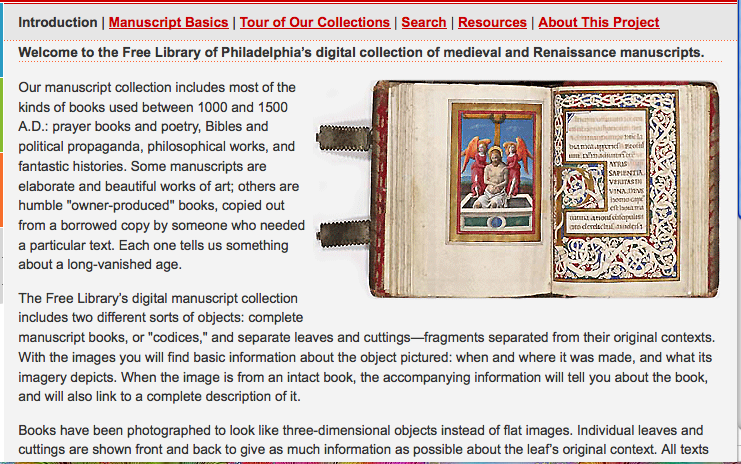
Medieval MS Collection at the Free Library of Philadelphia

Welcome Page from the Free Library of Philadelphia's digital manuscript collection

Sometimes I wish I lived on the East Coast, so I could visit collections like these in person.  However, even online, you will drool over this collection of medieval and Renaissance manuscripts.


Within This Site

 "Manuscript Basics" is an informative introduction to the types of medieval manuscripts, and how they were created.  The Glossary section has detailed entries for a variety of important terms.  Both of these are great for new scribes!

The "Tour of Our Collections" allows you to view individual manuscripts, page by page, and zoom in on the details.   Inspiration for drop-dead gorgeous scrolls abounds.

Also contained within this site are links to online resources and a bibliography with suggestions for further reading.  Anyone working on documentation for A&S will truly appreciate this.

The link to the "Leaves of Gold" exhibit on this site is a dead link; however, you can still access the Philadelphia Museum of Art exhibit at:

http://www.philamuseum.org/micro_sites/exhibitions/leavesofgold/gallery/boh/guide.html

Friday, January 25, 2013

Scribal Resource: Schoenberg Center for Electronic Text & Images

Sample MS page from SCETI

Schoenberg Center for Electronic Text & Images

from the University of Pennsylvania Libraries

Today's link is to an amazing collection containing nearly "nearly five hundred catalogued manuscripts and early printed books" from the University of Pennsylvania Libraries online collection.  Navigating and using the site takes requires a bit of experimentation, but with a little practice you can view, zoom and print these wonderful images. 

On the home page, you'll want to choose "Quick links to the individual collection home pages," and choose one of the collections.  For example, select:
  • Option 1: "Lawrence J. Schoenberg Manuscripts, Catalog and Database";
  • then " Medieval and Early Modern Works"; and 
  • "Browse the list of online facsimiles" to view a list of 65 digitized manuscripts.
I really like being able to zoom in and print images.  You can also bookmark individual manuscripts for future reference.